What is tribal knowledge?

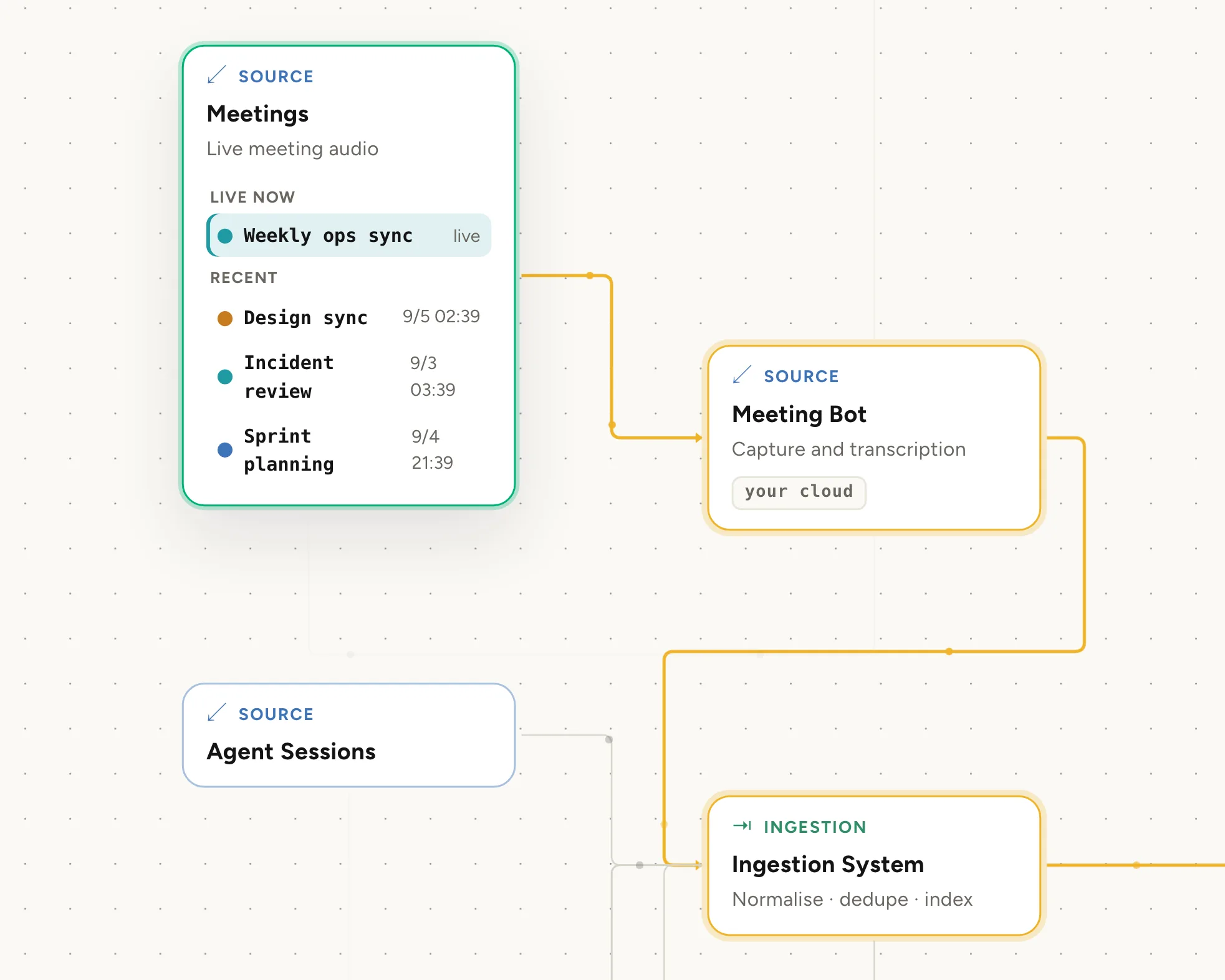
Tribal knowledge is the unwritten operational knowledge a company runs on: why decisions were made, which fixes work, which shortcuts are safe, which customers need special handling. It lives in the heads of tenured employees and spreads by conversation, so it leaves when they leave. Across 120 interviews with engineering leaders, we found that roughly 80% of this knowledge surfaces in meetings and agent sessions without ever reaching documentation. That is where it has to be captured.

A working definition

The term comes out of manufacturing, where quality engineers used it for the know-how that kept a line running even though no procedure mentioned it. In a modern company it covers everything your team knows that your documentation does not: the reasoning behind architecture choices, the workarounds that keep systems stable, the context behind customer relationships, the failed experiments nobody wants repeated.

Three properties make it distinctive. It is necessary: the company underperforms without it. It is unwritten: no system of record holds it. And it is social: it moves through conversation, apprenticeship, and shared experience, which makes it fast inside the group and invisible outside it.

What it looks like on an engineering team

A few recognizable examples:

  • The test suite that fails under load every Tuesday, and the shared understanding that a rerun is fine while a Wednesday failure means trouble.
  • The reason one service pins an old library version, known to two people, both of whom would have to be asked before an upgrade.
  • The customer whose data model predates the big migration, so every schema change needs a manual check that has never been written down.
  • The rollback of last year's queue migration, and the exact failure mode that makes retrying it a bad idea.

None of these live in a wiki. Each one surfaces in a meeting, a code review, or an agent session prompt when a veteran explains it, and then it sinks back out of sight.

Where it hides

This was the finding that shaped CentralAgent. Across our 120 interviews with engineering leaders, roughly 80% of the context that makes a veteran valuable never reaches documentation. It surfaces mostly in two streams: the meetings where people explain their reasoning out loud, and the agent sessions where engineers type context into tools like Claude Code and Cursor to get useful output. Both streams run every day at your company. Almost nobody mines either one.

Why documentation drives fail

You have probably run the experiment: a quarter where everyone commits to writing things down, a new wiki structure, a doc day. The push fades for predictable reasons. Writing is a tax, and it lands on your busiest, most knowledgeable people. Documentation goes stale the day the system changes, and stale docs are worse than none because they teach false confidence. And the deepest reason: veterans cannot list what they know. The knowledge only surfaces when a live situation calls for it, which is exactly when nobody has time to write.

What it costs you

The costs hide in line items you already pay. New engineers take months to become independent, because independence means having absorbed the unwritten context, and osmosis is slow. Senior people spend a chunk of every week as human routers for questions only they can answer. When one of them leaves, some part of the company's operating knowledge leaves with them, and you find out which part later, in production.

Agents made it more expensive

Tribal knowledge was costly when only humans needed it. Now your team runs coding agents all day, and every agent session starts with none of it. Engineers re-type the same background into prompts daily, and the agent still misses what it was never told.

Our benchmark shows the size of the gap. On real infrastructure questions, the same model resolved tasks in a median of 4 tool calls, 31 seconds, and $0.12 with structured company memory, against 22 calls, 122 seconds, and $0.64 without it. The difference between those two lines is tribal knowledge, encoded and loaded. You can run the benchmark yourself at /benchmarks.

How to capture it

Capture has to be passive, at the moments the knowledge surfaces on its own. CentralAgent captures meetings and agent sessions live, structures what it hears into layered agentic memory, and lets every employee and agent inherit the result. In a pilot, capture is live on day one and the first veteran-grade answers arrive inside the first week, judged against success criteria agreed in writing. The pipeline is laid out step by step in how CentralAgent works.

Is tribal knowledge bad?

No, and treating it as a disease misses the point. Tribal knowledge is the fastest medium a team has: a veteran transfers a subtle constraint in one sentence at standup, faster than any document could. The problem is fragility. It concentrates in a few heads, leaves when they do, and stays invisible to your agents. The goal is keeping the speed while removing the fragility: let the conversations happen exactly as they do today, and capture what they carry.

Related terms

Institutional knowledge is the broader category, covering documented and undocumented knowledge alike; tribal knowledge is the undocumented part. Agentic memory is the structured form tribal knowledge takes once captured, so agents can load it. If you want to see captured knowledge answering questions, start at the race demo, or book your setup call to start the 30-day free trial in your own cloud.