How CentralAgent works

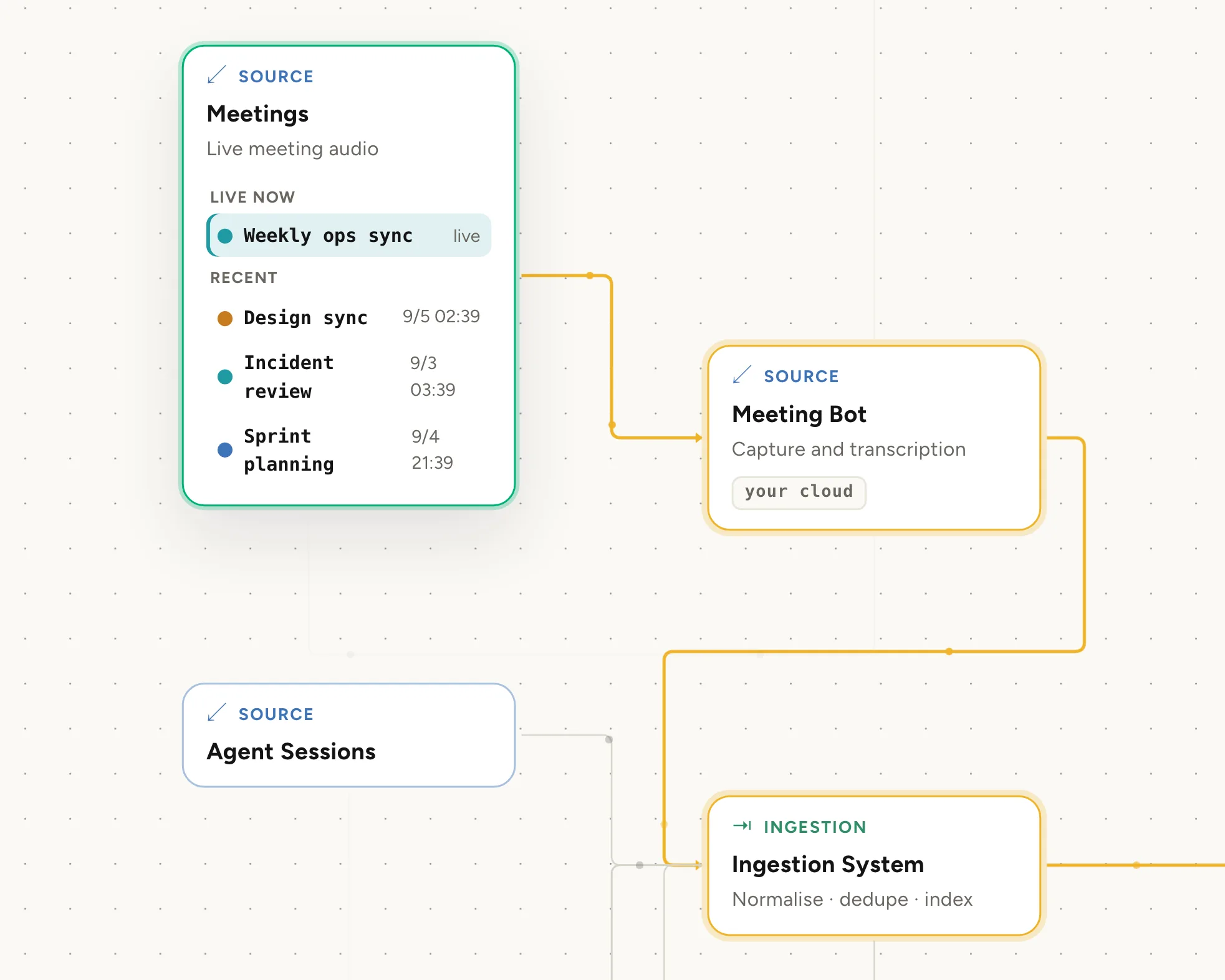
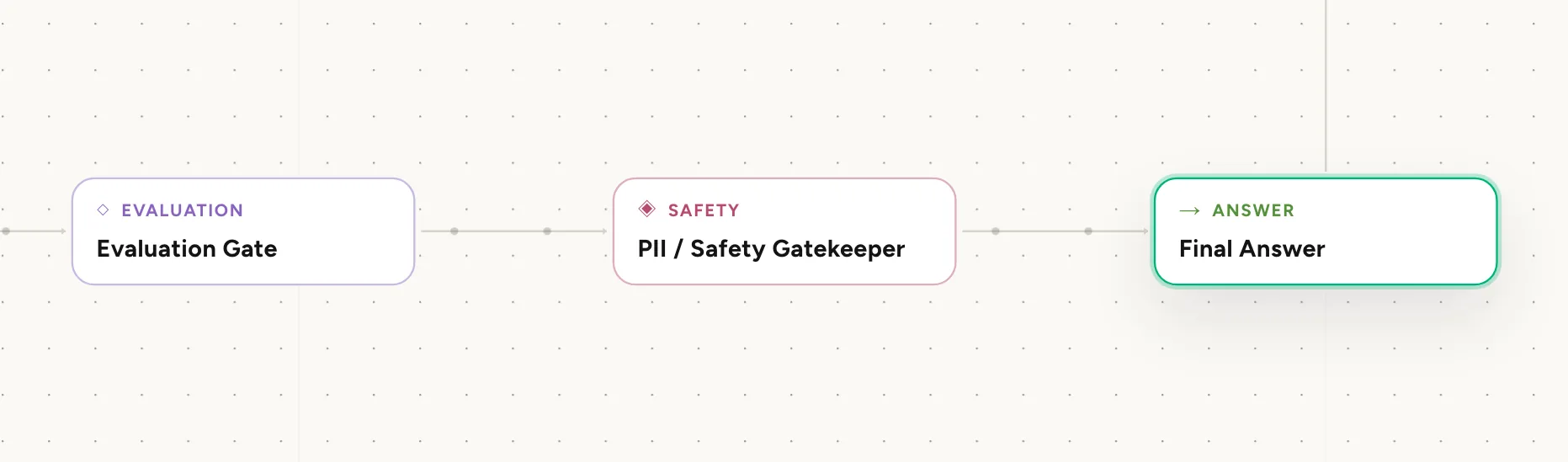
CentralAgent captures the knowledge your most tenured people carry in their heads, structures it into layered agentic memory, and lets every employee and every agent inherit it. Capture runs on your meetings and agent sessions. Structuring turns raw conversation into compact, layered records that fit inside an agent's context window. Inheritance means a new hire or a fresh agent session starts with your company's context already loaded. It deploys in your private cloud, and the first veteran-grade answers arrive inside week one.

The problem you already know

Every agent session starts from zero. Every new hire starts from zero. So you explain, again, why the deploy pipeline has a manual gate, which customer gets special handling, why the team abandoned the queue migration. Your most senior engineer spends afternoons answering questions she has answered fifty times, and the coding agents your team runs all day retain none of it.

Before building CentralAgent we ran 120 interviews with engineering leaders. One finding shaped the product: roughly 80% of the context that makes a veteran valuable never reaches documentation. It gets said in a meeting or typed into an agent session, used once, and lost.

Step one: capture

CentralAgent captures at the two places where that knowledge surfaces: your meetings and your agent sessions. It joins the calls your team already holds and reads the sessions your agents already run in tools like Claude Code and Cursor. Nobody writes docs, fills in templates, or sits for exit interviews. Capture is passive by design, because every method that depends on busy people writing things down has already failed at your company.

Capture goes live on day one of a pilot. From the first standup onward, the context your veterans give away in conversation stops evaporating.

Step two: structure

Raw transcripts on their own would just move the problem: a thousand hours of meetings is as unsearchable in text as it was in audio. So CentralAgent distills. It extracts decisions, constraints, fixes, and preferences, dates and attributes each one, resolves conflicts between old and new information, and files the result into a layered memory built around your company.

The architecture has three layers. At the base sits an industry blueprint, the general structure of how companies like yours operate, which gives every record a place to live. Above it sits your company layer: your systems, your people, your customers, your history of decisions and reversals. At the top are distilled memory records, compact entries small enough to justify their place in a context window.

Why layers? Because context windows are finite and companies keep growing. An agent handed everything you have ever captured would drown in it. Layers let each session load a small, relevant slice. The full reasoning is in what is agentic memory.

Step three: inherit

This is where the work pays out. When an agent starts a task, it loads the memory relevant to that task: the company-layer entries for the systems it touches, the distilled records of past decisions in that area. When a new engineer joins, she asks the question she would have saved for standup and gets the answer your principal engineer would have given, with the history behind it.

Two things change in practice. Your agents stop re-deriving your infrastructure from scratch every session. And your veterans stop being the routing layer for every question in the company.

What week one looks like

The pilot plan is deliberately concrete, because vague "transform your company" promises are how enterprise AI pilots die.

Day one: we deploy inside your private cloud and switch capture on for your meetings and agent sessions. Days two and three: the first structuring passes run, and you review the extracted records and correct anything that reads wrong. Day four: memory switches on for a pilot group of agents and people. Day five: you put your own questions to it and judge the answers against success criteria we agreed in writing before anything was installed.

First veteran-grade answers inside the first week. That is the scoped claim, and the only one we make.

The numbers behind it

We benchmark the same model on real infrastructure questions, with and without memory. The medians with memory: 4 tool calls, 31 seconds, $0.12 per task. Without: 22 tool calls, 122 seconds, $0.64. Same model on both sides, so the memory made the difference. The benchmark is reproducible, and you can run it yourself at /benchmarks.

Why this holds as models improve

Frontier models improve for everyone, including your competitors. They train on the public internet, and your decisions, constraints, and hard-won fixes are not in it. What CentralAgent captures is the one layer no model release can copy: how your company works. A stronger model with your context beats that same model without it, so every model release makes your memory worth more. And every captured week widens the gap between you and whoever starts later.

Where your data lives

In your cloud, full stop. CentralAgent deploys inside your private cloud, your data never leaves it, and we never train on it. SOC 2 is in progress. The full deployment model is documented at /security.

Start with a 30-day pilot

We deploy inside your private cloud. Capture starts day one, and your first veteran-grade answers arrive inside the first week. The 30-day trial is free, it starts with one setup call, and at day 30 you decide: keep the brain or we tear it down. Either way, we never held a copy of your data.

Book your setup call, or watch the race demo first. For the concepts behind the pipeline, read what is tribal knowledge and what is agentic memory.